

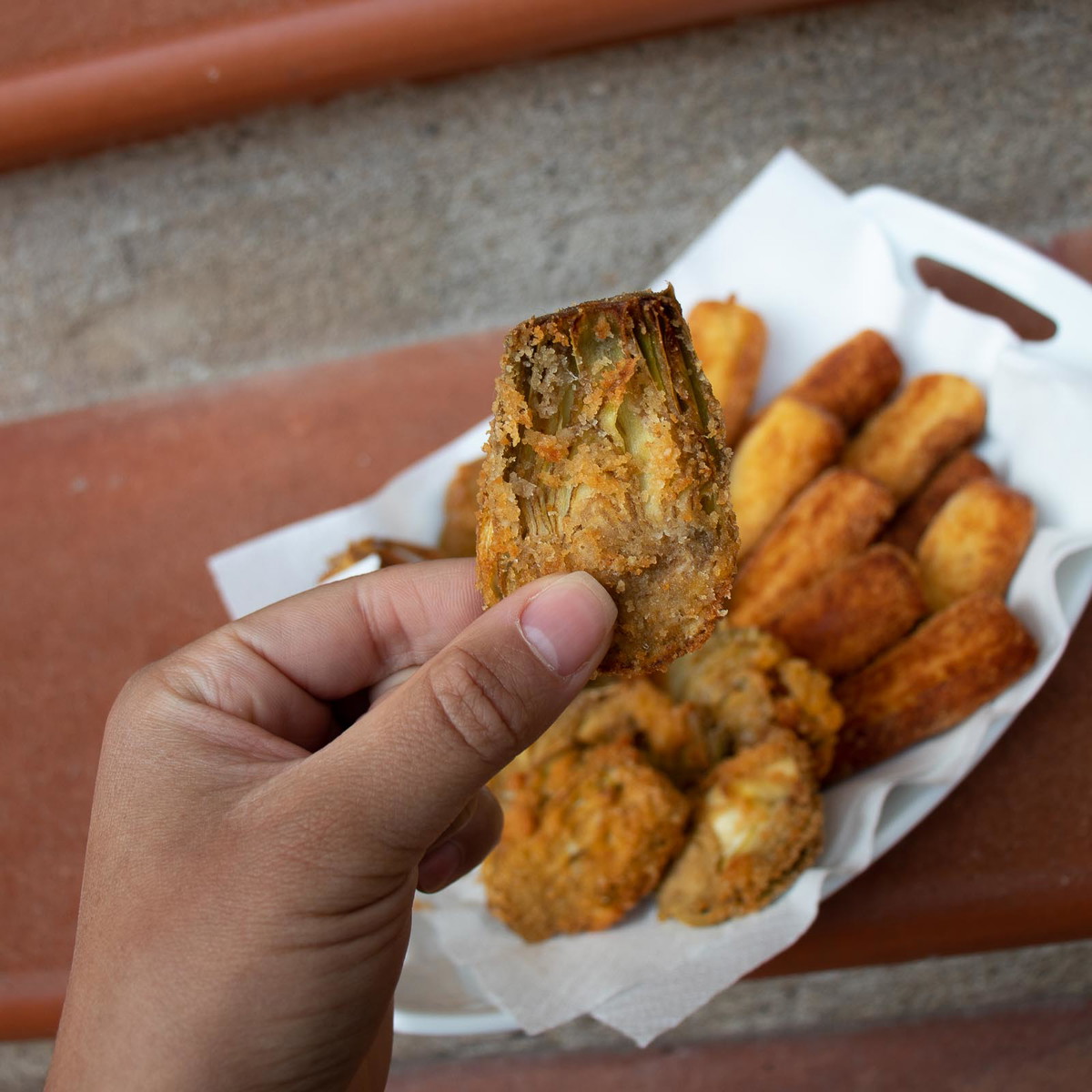
Fried artichoke hearts, known in Italian as carciofi fritti, are one of those dishes that seem simple until you actually make them. The batter has to be thick enough to coat without being heavy. The artichokes need to be boiled first so they cook through without burning. And the oil temperature has to be just right.
This is Lina's recipe, Giuseppe's Calabrian mother. It took a month and a half to write down, because Lina cooks entirely by feel, in the Italian tradition of "quanto basta," meaning "as much as it takes." We had to sneak a scale under the mixing bowl to get the measurements right. Her original instruction for the flour was "seven big spoonfuls." We have translated that into something a little more precise.
This recipe is part of our complete guide to Best Italian Fried Foods: A Regional Guide.

About Artichokes
Artichokes are the edible flower bud of a thistle plant native to the Mediterranean. Ancient Greeks and Romans considered them a delicacy, and they have been cultivated for thousands of years across Egypt, Tunisia, and the Italian peninsula. Today they are grown extensively in California, France, Italy, and Spain.
In Italy, artichoke season runs from December through May, with the peak falling in February and March. In southern Italy, they appear at the market in January and are abundant through spring. In the Northern Hemisphere more broadly, the main season runs February through May, with a smaller second harvest possible in fall.
Why You Must Boil First
Boiling the artichokes before frying is not optional. Raw artichoke hearts are too dense to cook through in the time it takes the batter to brown. Boiling them first guarantees a tender interior. If you skip this step, you risk fried artichokes that are beautifully golden on the outside and still tough on the inside.
While you clean and trim, rub every cut surface with lemon and keep the pieces in a bowl of lemon water. Artichokes oxidize quickly and turn brown on contact with air. The lemon prevents this.
The Key to a Good Batter
Lina's rule: the batter must be thick enough to coat the artichoke completely. Think very thick pancake batter. If it slides off, it is too thin. Add a small spoonful of flour and test again. If it will not pour at all, add a small splash of water.
Her technique is to cup the artichoke piece in a large spoon, pour more batter over the top to coat it fully, and then gently lower it into the oil without letting the spoon touch the oil. This keeps the coating intact and prevents splashing.
Ingredients
For Boiling
- 1 lemon
- 1 tbsp salt
For the Batter and Frying
- 500 g artichoke hearts and stems, trimmed (approximately 5 medium artichokes)
- 250 g (about 2 cups) flour
- 250 g (1 cup) room temperature water
- 10 g Parmigiano Reggiano, finely grated
- 1 medium egg
- 2 pinches salt
- ¼ tsp black pepper
- Extra virgin olive oil for frying (or your preferred frying oil)
How to Make Fried Artichoke Hearts
Step 1: Trim and Boil the Artichokes
- Bring a large pot of water to a boil and add the salt. Squeeze half a lemon into a large bowl of water and keep the other half by your cutting board.
- Chop off the bottom ½ inch of the artichoke stem. Rub the cut with lemon. Then cut off the entire stem from the base. Rub all cut surfaces with lemon. Chop the stem into 2 to 3 pieces and place in the lemon water.
- Pull off the hard outer leaves layer by layer, peeling down and away. Remove at least 3 to 4 layers until the leaves start to feel softer and more tender. Rub any exposed surfaces with lemon as you go. Do not be stingy about how much you remove. Leaving too many tough leaves results in chewy, stringy fried artichokes.
- Lay the artichoke on its side and cut off the top ½ inch to remove the spiky tips. Rub with lemon.
- Cut the artichoke in half lengthwise, then cut each half into thirds or quarters. Pieces should be roughly ¾ inch thick and up to 2 inches tall. Remove any remaining tough leaves and place immediately in the lemon water.
- Rinse the artichoke pieces and add to the boiling water. Cook for 3 to 4 minutes. Remove and drain in a strainer. Let dry and cool for 10 to 20 minutes before frying.
Step 2: Make the Batter and Fry
- Add the flour to a large bowl and make a well in the center. Add the egg, then the water, parmigiano, salt, and pepper. Stir until smooth with no lumps. The consistency should be very thick pancake batter. Adjust with a small spoonful of flour or water as needed.
- Heat a large pan over medium or medium-low heat with ½ to ¾ inch of olive oil. Do not use high heat. Test the oil with a pinch of flour. When it sizzles, the oil is ready.
- Fold the artichoke pieces into the batter. Using a large spoon, cup each piece and add more batter on top to coat fully. Gently lower into the oil. The artichokes should sizzle immediately and bubble lightly on the sides.
- Cook for approximately 2 minutes per side, until light golden brown. If the artichokes brown faster than this, reduce the heat slightly. You want even color all the way through.
- Remove and drain on a plate lined with paper towels. Sprinkle with salt and serve immediately.
Frequently Asked Questions
Can I Use Canned or Frozen Artichoke Hearts?
Canned artichoke hearts in water can work, but drain and pat them very dry before battering. Excess moisture will cause the batter to separate from the artichoke in the oil. Frozen artichoke hearts should be fully thawed and dried before use. Fresh artichokes properly trimmed and boiled will always give the best result.
What Oil Should I Use for Frying?
We fry with extra virgin olive oil almost exclusively, but it is not required here. Any neutral frying oil works. If you do fry with olive oil, keep the heat at medium or medium-low. Olive oil begins to smoke at high heat, which affects the flavor and the coating.
Why Is My Batter Falling Off in the Oil?
Two likely causes: the artichokes were not dry enough before battering, or the batter was too thin. Make sure the boiled artichokes are fully cooled and dry before you coat them, and check that your batter holds its shape on the back of a spoon without running.
Can I Make These Ahead?
Fried artichokes are best eaten immediately. They lose their crispiness quickly as they sit. That said, you can trim and boil the artichokes a day ahead and store them in the fridge. Make the batter and fry just before serving.
What Is the Italian Name for This Dish?
Carciofi fritti, which simply means fried artichokes. You will also see carciofi alla giudea, a flattened and deep-fried version from Rome that is crispier and more open in texture. This recipe is the Calabrian style, with a batter coating rather than a direct fry.
You may also like:
Fried Potatoes and Peppers (Patate e Peperoni)
Fried Cuttlefish (Seppie Fritte)
Vrasciole — Calabrian Fried Meatballs
Every recipe in our kitchen starts with our family's extra virgin olive oil, cold-pressed from groves along the Ionian coast of Calabria that have been in Giuseppe's family since 1927. It is what we use every day, and it makes a genuine difference in dishes like this one. Shop our olive oil here.
We wrote a book called The Olive Oil Enthusiast. Order your copy today.
Made this recipe? Tag your photos with #EXAUoliveoil and follow us on Instagram, Facebook, TikTok, and YouTube for more recipes.


Leave a comment