

Pasta al pomodoro is five ingredients and thirty minutes. It is also one of the most unforgiving recipes in Italian cooking — there is nowhere to hide, so every ingredient has to earn its place. Great tomatoes, a good garlic technique, fresh basil, and an honest extra virgin olive oil are all you need. Here is how to make it properly.
This recipe is part of our complete guide to oil-based Italian sauces.
How do you make authentic Italian Pasta al Pomodoro?
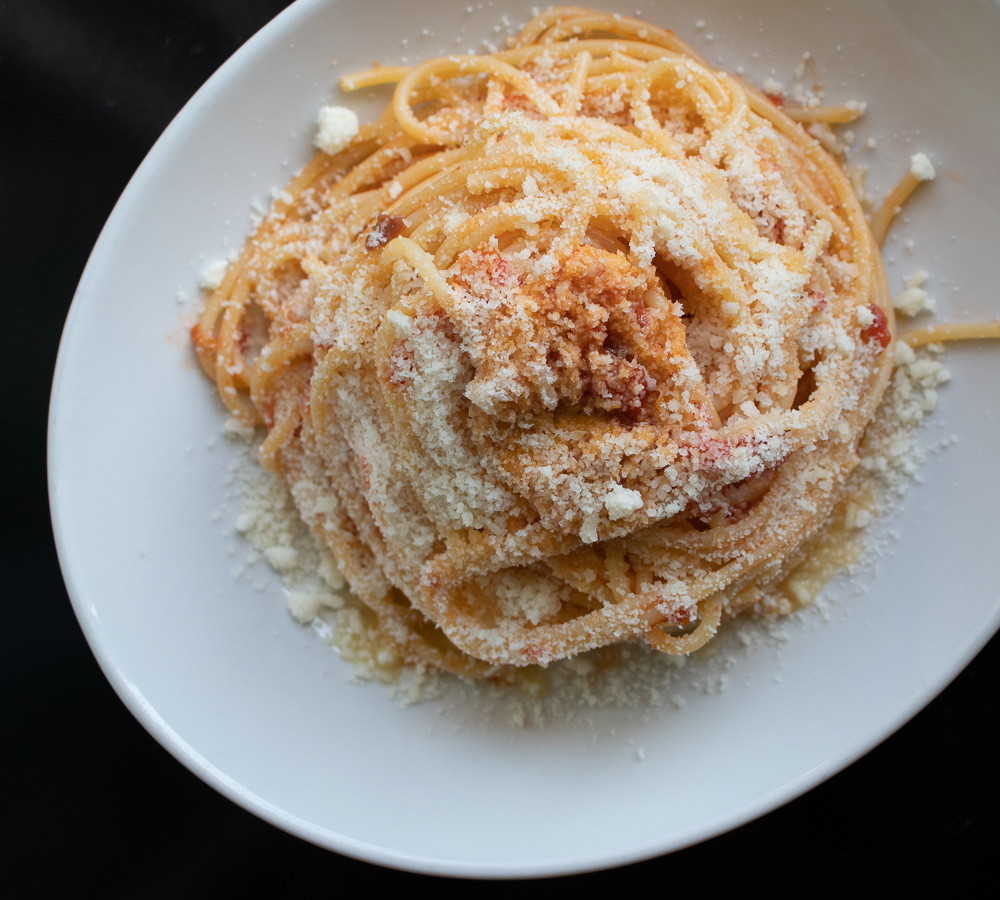
To make authentic Pasta al Pomodoro, scent extra virgin olive oil with smashed garlic and Calabrian peperoncino before adding fresh, ripe tomato chunks. Cook the sauce until thick, then transfer par-cooked pasta directly into the pan. Finish by stirring over high heat with a splash of starchy pasta water to emulsify the fats and liquids into a glossy coating. Serve immediately with fresh basil and a generous raw drizzle of high-quality EVOO.
A Dish Born in Naples
Pasta al pomodoro was created in Naples in the early 1800s by Ippolito Cavalcanti. The original version was called Vermicelli al Pomodoro — vermicelli being a thicker, slower-cooking ancestor of modern spaghetti, traditionally eaten by hand. The simplicity was always the point: ripe tomatoes, oil, and pasta. That has not changed.
Today it is a staple of Italian home cooking, the kind of dish every Italian family makes slightly differently. In Calabria, the version tends to lean on a Calabrian peperoncino for heat and a more generous pour of olive oil than you might expect. That generosity is not an accident — Calabria is Italy's second largest olive oil producer, and olive oil is treated as an ingredient, not a condiment.
The Tomato Question
The tomatoes are the dish. Everything else is support. Use the ripest, most flavorful fresh tomatoes you can find — we prefer smaller varieties like 3-inch tomatoes, which have a natural sweetness and low water content. If good fresh tomatoes are not in season, a high-quality canned San Marzano is a better choice than a flavorless winter tomato.
One thing worth noting: tomatoes share something with olives that most people do not realize. Just like olives are technically a fruit, not a vegetable, so are tomatoes — botanically a berry, grown from the flower of the plant and containing seeds. Both taste savory, both are used in savory cooking, and both are fruits by every botanical definition. We find it fitting that two of Italy's most important ingredients share that quirk.
Why the Olive Oil Matters Here
This dish uses olive oil twice: once to build the sauce base by infusing the garlic, and again as a raw finish over the plated pasta. Both applications are doing different things and both require a quality extra virgin.
The cooked application carries the garlic's flavor through the sauce — a neutral oil would make the base flat. The raw finish at the end is where a good EVOO really shows itself: its grassy, peppery notes brighten the sweetness of the tomatoes in a way that nothing else can replicate. The oleocanthal in extra virgin olive oil — the compound responsible for that characteristic peppery throat finish — is only present in unrefined, cold-pressed oil. It is also associated with anti-inflammatory properties in the research literature.
If you are buying olive oil at the supermarket, read our guide to navigating grocery store olive oil before you shop — most bottles on that shelf are not what they appear to be. And if you follow a plant-based diet, olive oil is completely vegan — no animal products involved at any stage of production.
This pasta, made with fresh tomatoes, garlic, olive oil, and basil, is also a textbook Mediterranean diet meal — the kind of simple, plant-forward, olive oil-rich cooking that research consistently associates with longevity and cardiovascular health.
Ingredients
- 10 tomatoes, approximately 3 inches each
- 1 garlic clove, smashed or cut in half
- 4 fresh basil leaves
- 2 tbsp extra virgin olive oil, plus more for finishing
- 350 g spaghetti or penne
- Salt
- 1 Calabrian peperoncino, chopped into 2–3 pieces (optional)
- ¼ cup finely grated Parmigiano Reggiano (optional)
Directions
- Fill a medium-large pot with water and salt generously — it should taste like the sea. Bring to a boil.
- Cut the tomatoes into 1-inch chunks and set aside.
- Smash the garlic clove with the flat side of a knife or cut each clove into 2 to 3 large pieces. Do not chop it fine — small pieces burn quickly. If using the Calabrian peperoncino, chop into 2 to 3 pieces as well.
- Heat a medium-large frying pan over medium heat. Add the olive oil, garlic, and peperoncino. Cook for 1 to 2 minutes, until the garlic turns a warm, buttery yellow color and has scented the oil. Tip the pan slightly to let the garlic and oil pool over direct heat — a gentle sizzle is what you want. Watch it carefully; burned garlic ruins the entire dish.
- Add the tomatoes and stir with a wooden spoon. Cover with a lid and cook on medium heat for 12 to 15 minutes, stirring every 3 to 4 minutes. The tomatoes should break down into a thick, saucy consistency that coats the back of a spoon.
- While the tomatoes cook, finely grate the Parmigiano Reggiano if using.
- At the very end of the cooking time, add the basil leaves and 1 tsp salt. Taste and adjust. The sauce should be smooth but thick — if it is too thin, cook uncovered for a few more minutes or simply turn off the heat and let it sit. If it is too thick, a splash of pasta water will fix it in step 10.
- Add the pasta to the boiling water, stirring every few minutes. Cook until 3 minutes before al dente (check the package for timing). Reserve 2 cups of pasta water, then drain.
- Turn the sauce to medium heat. Add a splash of pasta water and stir.
- Add the drained pasta directly to the sauce. Increase to high heat and stir continuously — clockwise or counterclockwise, pick one and stay with it — for about 3 minutes. Add more pasta water in half-ladle increments as the sauce thickens and starts to dry out. Keep everything at a rolling boil throughout this step.
- Remove from heat. Stir in the Parmigiano Reggiano if using.
- Plate immediately and finish each bowl with a drizzle of extra virgin olive oil.
Tips and Notes
Salt your water properly. Under-salted pasta water is the single most common reason a pasta dish tastes flat. It should taste seasoned, not like ocean water, but noticeably salty.
Keep the garlic large. This is one of the most common mistakes in Italian tomato sauce. Small garlic pieces burn before the oil is ready, turning bitter. Smashed or large-cut garlic flavors the oil gently and can be left in or removed before serving.
Finish the pasta in the sauce. The 3 minutes of high-heat stirring at the end is what makes this dish. The pasta absorbs the sauce, the starchy water emulsifies everything, and the result is a cohesive, glossy plate — not pasta with sauce dumped on top.
The finishing drizzle is not optional. Raw EVOO over the plated pasta adds brightness and aroma that the cooked oil cannot provide. Use the good stuff here.
Frequently Asked Questions
Can I use canned tomatoes instead of fresh?
Yes. If fresh, ripe tomatoes are not in season, a high-quality canned San Marzano or whole peeled Italian tomato is a better option than a pale, flavorless fresh tomato. Crush them by hand before adding to the pan and reduce the cooking time slightly since canned tomatoes are already soft.
What pasta shape is best for pasta al pomodoro?
Spaghetti is the most traditional choice and works beautifully with a fresh tomato sauce. Penne is a good option if you prefer something with more texture to catch the sauce. Avoid very thick shapes — this is a light sauce, not a ragù.
Is pasta al pomodoro vegan?
Yes, the base recipe is completely plant-based — tomatoes, garlic, basil, olive oil, and pasta. Skip the optional Parmigiano Reggiano to keep it fully vegan. Extra virgin olive oil is always vegan.
Why does my sauce taste flat?
Three likely causes: under-salted pasta water, low-quality olive oil, or tomatoes that were not ripe enough. Each one independently flattens the dish. Salt the water well, use a real extra virgin olive oil, and taste your tomatoes before you cook them. If they are bland raw, they will be bland cooked.
Every recipe in our kitchen starts with our family's extra virgin olive oil, cold-pressed from groves along the Ionian coast of Calabria that have been in Giuseppe's family since 1927. It is what we use every day — and it makes a genuine difference in dishes like this one. Shop our olive oil here.
We wrote a book called The Olive Oil Enthusiast. Order your copy today.
You May Also Like:
If you make this recipe, please leave a comment and give it a rating — we read every one. If you are on Instagram, TikTok, or Facebook, tag us with #EXAUoliveoil so we can repost.
Made this recipe? Tag your photos with #EXAUoliveoil and follow us on Instagram, Facebook, TikTok, and YouTube for more recipes.


Leave a comment