




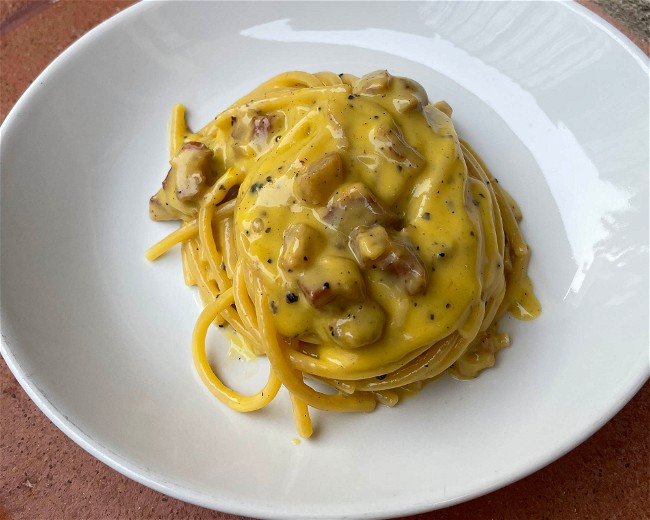
Eggs, guanciale, pecorino, and pasta. Pasta alla carbonara is one of the most beloved Italian dishes in the world, and it is easy to understand why. It is rich, satisfying, and built entirely on technique rather than a long ingredient list.
It is also one of the most adulterated dishes in Italian cuisine. Cream, garlic, mushrooms — the additions are endless and almost universally wrong. This is Giuseppe's version, the one he has been making his whole life, and it is as close to the original as it gets. Carbonara is one of several great Italian meat-based preparations — if you want to explore the full tradition, from ragù alla bolognese to Calabrian frissurata, see our complete guide to meat-based Italian sauces.
The Origin of Pasta Alla Carbonara
Italians love to debate the origins of their dishes, and carbonara is no exception. There are three main theories, each with compelling evidence behind it.
The Apennine Origin Story
The oldest theory traces carbonara to the charcoal workers of the Apennine mountains, known as the Carbonari. These workers needed simple, portable food that could be prepared from locally available ingredients. They made a dish called cacio e ova, originally from Lazio and Abruzzo, which many believe evolved into carbonara over time.
Pepper was readily available because it was used to preserve pork. Olive oil was too expensive for most workers, so animal fat or lard was used instead. The term "Carbonada" in Abruzzo also refers to pancetta cooked on coals, which adds another layer to this origin story.
The Neapolitan Origin Story
A second theory connects carbonara to Neapolitan cuisine, pointing to an 1837 treatise by Ippolito Cavalcanti. Neapolitan cooking has long used the technique of finishing pasta with beaten egg, cheese, and pepper. This same method appears in dishes like pasta with peas, pasta with zucchini, and meat stew with peas, all predating the more commonly cited origin stories.
The Allied Origin Story
The most widely accepted theory places the birth of carbonara in Rome in 1944. Following the liberation of the city during World War II, chef Renato Gualandi created the dish using military rations distributed by Allied troops — eggs, bacon, and pasta, with the bacon brought by American soldiers.
Gualandi rendered the bacon fat slowly and created a creamy sauce using eggs, black pepper, and grated cheese. He served as chef for the Allied troops in Rome from September 1944 to April 1945, and during that period carbonara spread quickly across the capital.
This theory also explains why pancetta and guanciale are often treated as interchangeable in carbonara recipes, unlike in other Roman dishes such as amatriciana. We think carbonara is the result of Italian culinary improvisation at its finest — a masterpiece born during one of the most difficult periods in modern history.
The Correct Name for This Dish
The full Italian name is Pasta alla Carbonara or Spaghetti alla Carbonara. In English, it is often shortened to Pasta Carbonara or simply Carbonara. All are acceptable, though the full name is more precise.
The Rules of Authentic Pasta Carbonara
This is Giuseppe's recipe, refined over years. When we first met, carbonara was one of the first dishes he made for me. After moving to the United States, he had to substitute guanciale for bacon, and honestly we almost prefer it. The smokiness of good bacon adds a dimension that works beautifully in the dish.
That said, there are rules. Carbonara is deceptively simple, and its simplicity is exactly what makes it special. Here is what does not belong:
- No cream or milk
- No garlic
- No onions
- No parsley
- No mushrooms or other vegetables
- Only Parmigiano and Pecorino for the cheese
No Cream
Authentic carbonara is rich and creamy without any cream or milk. The sauce comes entirely from emulsified egg yolk, cheese, rendered fat, and starchy pasta water. Once you learn the technique, you will not miss the cream.
No Garlic or Onion
Traditional carbonara does not include garlic or onion. The smokiness and depth of guanciale or bacon carry the flavor entirely on their own. Adding alliums changes the dish into something else.
No Parsley
Parsley is a wonderful herb in many contexts, but it does not belong here. The flavor profile of carbonara is intentionally tight and focused. Parsley muddies it.
No Mushrooms or Other Vegetables
Carbonara has four ingredients. If you are adding mushrooms or broccoli, you are making a different dish, and that is fine, but call it something else.
How to Make Classic Pasta Alla Carbonara
First, bring a large pot of water to a boil. While waiting, grate the cheeses and slice the guanciale or bacon into pieces about 1/4 inch thick.
Add the guanciale to a large cold pan and heat on low. This step is critical. The fat needs to render fully and slowly, which can take ten to fifteen minutes. Do not rush it.
While the fat renders, mix together the egg yolks, grated cheese, and a generous amount of freshly cracked black pepper in a bowl. Set aside.
Once the fat has fully rendered, remove the guanciale from the pan using a slotted spoon and set it aside. Keep the rendered fat in the pan.
Generously salt the boiling water and add the pasta. Cook until two to three minutes before al dente. Reserve at least one full cup of pasta water before draining.
Shortly before removing the pasta, add one ladle of pasta water to the rendered fat in the pan. Turn the heat to high and bring to a boil. Add the pasta directly to the pan and stir continuously. Add more pasta water as needed and cook for an additional two to three minutes.
Cut the heat completely. Add the egg and cheese mixture and stir continuously to prevent scrambling. The residual heat will cook the eggs gently into a silky sauce. Add the guanciale back in, plate immediately, and serve.

Frequently Asked Questions
What pasta shape is best for carbonara?
Spaghetti is the most traditional choice. Rigatoni is also widely used in Rome and works well because the tubes trap the sauce. Avoid fresh egg pasta here, as it tends to become too soft when combined with the egg yolk sauce.
Can I use bacon instead of guanciale?
Yes. Guanciale is traditional and worth seeking out, but thick-cut bacon is a perfectly good substitute. The smokiness of bacon actually adds a dimension that many people prefer. Pancetta is another option and sits between the two in flavor.
Why does my carbonara turn into scrambled eggs?
The pan is too hot when you add the egg mixture. You must cut the heat completely before adding the eggs, and stir constantly. The residual heat from the pasta and pan is all you need to cook the sauce through.
Does authentic carbonara have olive oil?
No. Traditional carbonara is built entirely on rendered guanciale fat, which provides all the fat the dish needs. Extra virgin olive oil is not part of this recipe, though it is central to most other Italian cooking. If you are curious about the role of olive oil in Italian cuisine more broadly, our guide to extra virgin olive oil is a good place to start.
Is carbonara a Roman dish?
It is strongly associated with Rome, though as the origin stories above show, its roots are debated. Today it is considered a pillar of Roman cuisine alongside amatriciana, cacio e pepe, and gricia.
We wrote a book called The Olive Oil Enthusiast. Order your copy today.
Every recipe in our kitchen starts with our family's extra virgin olive oil, cold-pressed from groves along the Ionian coast of Calabria that have been in Giuseppe's family since 1927. Carbonara is one of the few exceptions, but when olive oil is called for, it is always ours. Shop our olive oil here.
You may also like:
Guide to Meat Based Italian Sauces
Made this carbonara? Tag your photos with #EXAUoliveoil and follow us on Instagram, Facebook, TikTok, and YouTube for more recipes.


Leave a comment